
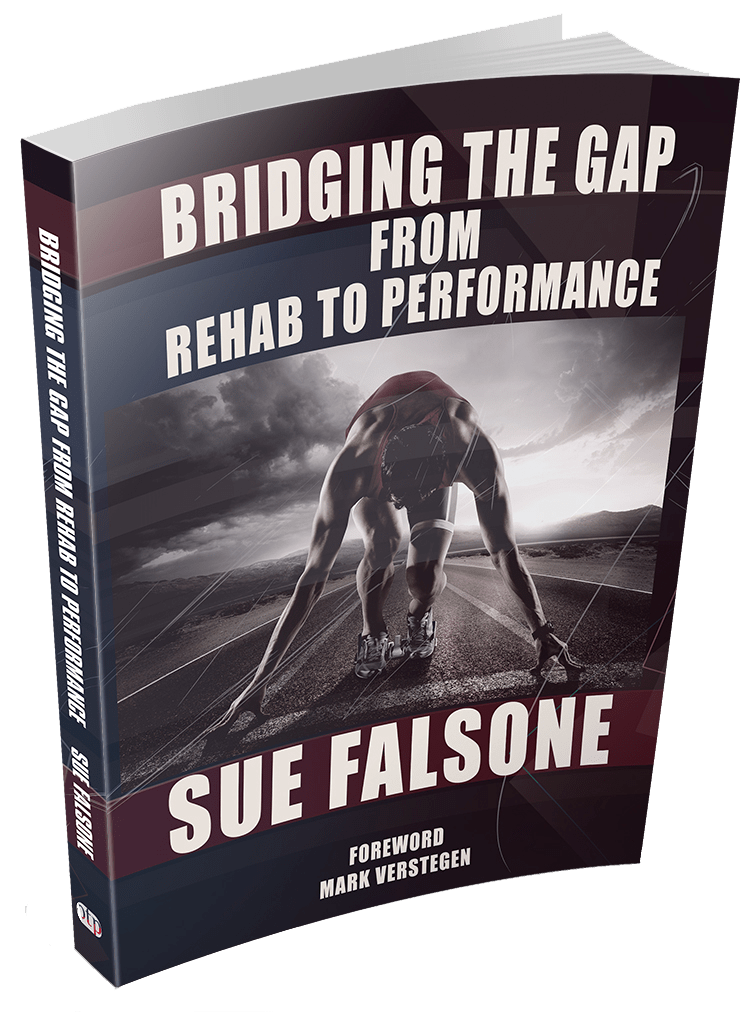
Sue Falsone, PT, DPT, MS, SCS, ATC, CSCS, COMT, RYT, FNAP, is the author of Bridging the Gap from Rehab to Performance – a best-selling and groundbreaking book that has redefined how healthcare professionals approach the continuum from injury recovery to high-level athletic performance. Drawing on two decades of experience working with elite athletes in MLB, the NFL, and Olympic sport, Sue brings a rare blend of clinical expertise and practical field application.
Published in 2018, Bridging the Gap offers a comprehensive, systems-based framework for navigating the return-to-play process. Sue’s writing challenges outdated silos in healthcare, promoting collaboration between physical therapists, athletic trainers, strength coaches, and sports medicine professionals.
Purchase from these retailers:
About bridging the gap from rehab to performance
Publication & Scope
- Bridging the Gap from Rehab to Performance is a book by Sue Falsone (published in 2018) that offers a comprehensive framework for guiding athletes from injury all the way back to high-level performance.
- The book is targeted at clinicians, athletic trainers, strength & conditioning coaches, and other performance professionals. It’s meant to be a system-oriented guide rather than a prescriptive “one size fits all” manual.
Structure & Contents
- The content is organized along a continuum rather than in discrete, isolated phases. It starts from initial injury/pain, then moves through stages such as tissue healing, psychomotor and somatosensory control, fundamental performance, and finally advanced performance.
- There are multiple appendices and assessment tools included (e.g., Janda Functional Assessment, FMS, SFMA, etc.), plus a set of illustrations, graphics, and references to support both theory and clinical application.
Key Concepts & Philosophy
- Sue emphasizes the idea of a continuum (rehab → performance) rather than a sharp division. Rehabilitation and performance training overlap, and many factors (strength, mobility, pain, neuromuscular control, psychology) need to be addressed simultaneously or in sequenced phases.
- She promotes interdisciplinary collaboration, recognizing that no single discipline (PT, ATC, S&C, etc.) can “do it all.” Successful outcomes depend on teams with shared philosophy, communication, and cooperation.
- There’s a strong emphasis on individualized care—each athlete’s needs, injury history, sport, biomechanics, and psychological status matter. Generic programs aren’t enough.
Learn more about the book and get a free sample chapter.
Collaborations
I have collaborated with other authors on several projects and publish in medical journals.

Edited by: Rebecca Sametz, Leslee Taylor & Sara Johnston
Chapter 8. Qualities of Women Leaders and How They Survive

Edited by: Bryan Guzski & Time Reynolds
Book chapter

Author(s): David Joyce and Daniel Lewindon
Chapter 5: Optimizing Flexibility

Author(s): Barb Hoogenboom, Mike Voight and Bill Prentice
Chapter 18: Functional Exercise Progression and Functional Testing in Rehabilitation

Edited by: Brian Hainline and Robert Stern
Chapter 38: Common Peripheral Nerve Injuries in Sport: Diagnosis and Management

Author(s): Kelly Bliven
Question 36: What Are Important Considerations in Managing the Adolescent Baseball Pitcher with Shoulder Pain?
Question 37: What Are the Components of a Safe and Effective Return to Throwing Program?

Author(s): Craig Liebeneson, DC
Chapter 3: Bridging the Gap from Rehabilitation to Performance
Chapter 23: Running in Sport

Author(s): James R. Andrews MD, Kevin E. Wilk PT DPT, Michael M. Reinold DPT ATC CSCS
Chapter 56: Core Stabilization: Integrated with Shoulder Rehabilitation